From commuting to job satisfaction: how cycling boosts mental fitness
Mental fitness is one of the biggest challenges for modern organizations. High workloads, constant stimulation, and sedentary lifestyles mean employees are increasingly struggling with stress, difficulty concentrating, and fatigue.

At the same time, employers are seeking solutions that go beyond isolated interventions. Solutions that structurally contribute to well-being and performance. Cycling proves surprisingly effective in this regard.
The mental impact of exercise
Exercise has a direct effect on the brain. Cycling releases stress hormones and releases endorphins. The result: a clearer mind, improved mood, and greater mental resilience.
Unlike intense workouts, cycling is accessible and repeatable. It's precisely that regularity that makes its effect so powerful.
Commuting as a mental reset
For many employees, commuting is a source of stress. Traffic jams, crowded trains, and time pressure create a tense start and end to the workday.
Cycling turns this moment into a mental transition:
- From private to work (focus)
- From work to private life (unloading)
Employees who cycle demonstrably arrive feeling fresher and release work stress more easily.
Wheel-Being and Mental Health
Wheel-Being consciously uses cycling as a tool for mental fitness. The program includes elements such as:
- Mindful rides
- Recovery rides
- Lunch & Learn sessions on brain and movement
- Trajectories focused on energy and balance
This creates attention for mental health without heavy labels or medical processes.
Social connection as a protective factor
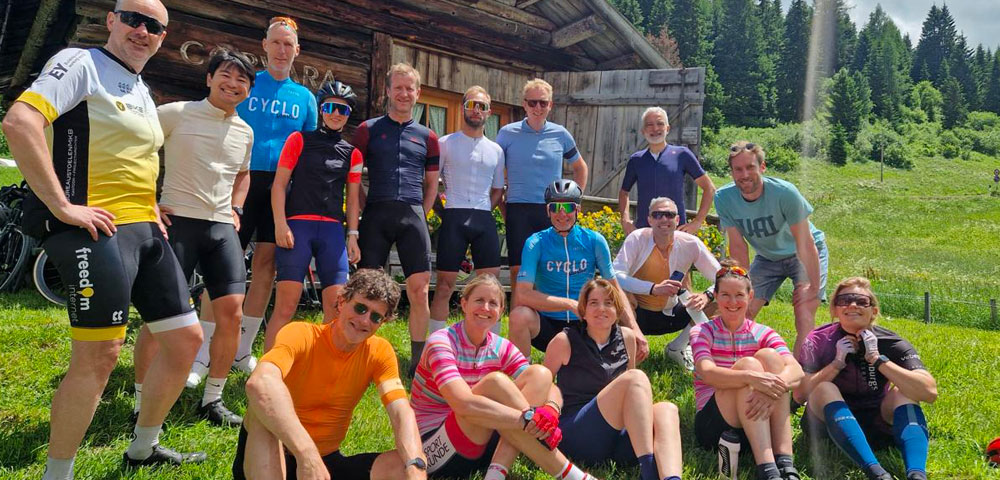
Mental fitness is strongly influenced by social connection. Cycling together, sharing experiences, and achieving goals strengthens team spirit and reduces stress.
Within Wheel-Being, informal networks emerge:
- Colleagues cycling together
- Teams that motivate each other
- Managers who participate as role models
This contributes to psychological safety and job satisfaction.
From prevention to performance
Mental vitality isn't a soft topic. Employees with greater mental resilience:
- Make better decisions
- Are more creative
- Have less absenteeism
- Remain employable for longer
By structurally integrating cycling, organizations not only invest in well-being, but also in performance.
Conclusion
Workplace happiness doesn't arise in a workshop, but in everyday life. Cycling makes mental fitness part of the routine.
Wheel-Being makes movement natural, social, and fun. That's precisely why it works. Not as a standalone project, but as a lasting cultural shift.
Cyclosportive Travel helps employers to actually get employees moving. Wheel-Being gives organizations control over vitality – and employees the energy to grow.