This is why everyone loves the gravel in Tuscany, and especially Siena.
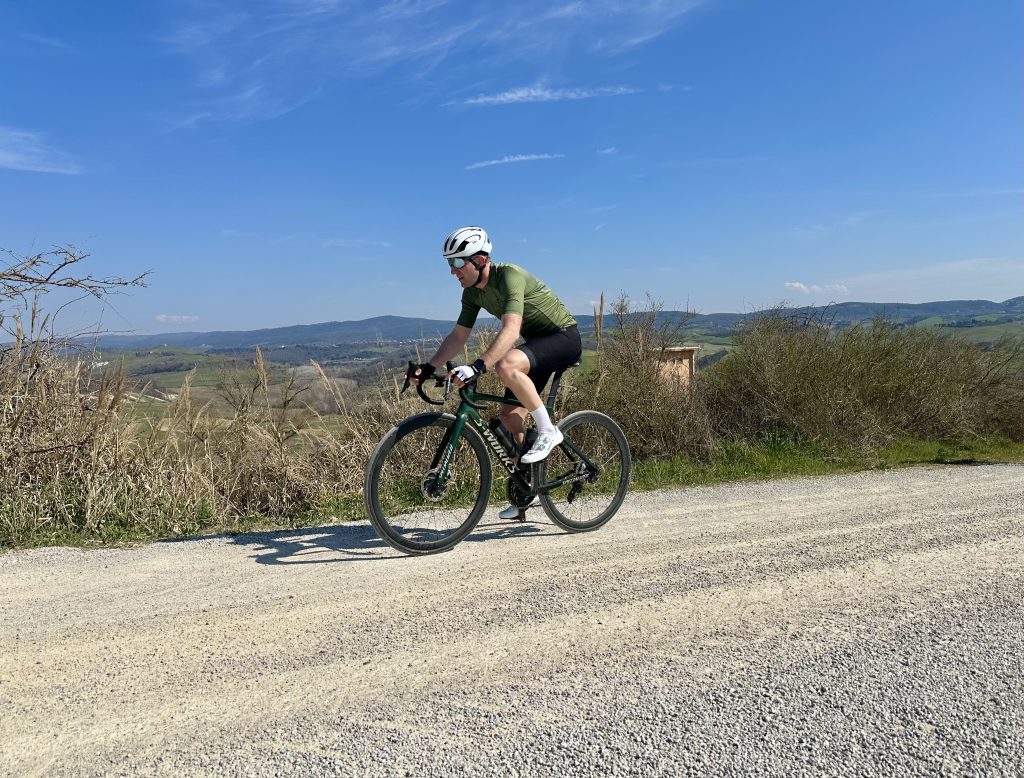
Many cyclists return from Tuscany with beautiful photos, a few famous climbs, and fond memories. But deep down, the same feeling often gnaws: was this really the Tuscany everyone talks about? For the true sense of magic only begins once you leave the paved roads and turn onto the iconic white gravel roads around Siena.
There, amidst the dust, the cypresses, and the endless rolling hills, you discover why so many cyclists become completely addicted to this region.
Also read: Custom cycling tours: Why standard providers never truly understand your dream
Why the gravel roads around Siena are so special
The area around Siena is world-famous thanks to the legendary sterrati: white gravel roads that wind through the Tuscan landscape. These roads are no ordinary gravel strips. They form the heart of the mythical cycling classic Strade Bianche and offer a combination that you will find almost nowhere else in Europe:
- rolling panoramas
- endless peace
- technical descents
- steep gravel climbs
- perfect mix of adventure and beauty
The result? Every ride feels like a mini-epic.
The sore point of many cycling holidays: beautiful surroundings, but little experience.
Many popular cycling destinations have excellent asphalt and beautiful views. But often one thing is missing: genuine emotion. The gravel roads around Siena solve that problem immediately.
Here you feel:
- the tension of loose gravel under your tires
- the rhythm of long Tuscan climbs
- the silence of deserted hills
- the satisfaction of every unpaved stretch
It makes your ride not only more beautiful, but also more memorable. And that is exactly why cyclists keep coming back.
Also read: Combine the pro race with cycling the GF Strade Bianche yourself.
The white roads of Tuscany feel like cycling through a postcard.
Anyone driving along the famous white gravel roads for the first time immediately understands why this region is so iconic.
You cycle past:
- winding cypress avenues
- golden hills
- old farmhouses
- medieval villages
- deserted country roads without traffic
Sometimes it seems as if time has stood still here. For photographers, gravel riders, and adventurous cyclists, this is pure bucket list content.
Also read: Cycling in Tuscany? That's why Siena is the smartest base for road cyclists.
Gravel around Siena is challenging, but surprisingly accessible.
Many cyclists think that Tuscan gravel is extremely technical or only for experienced bikepackers.
That is incorrect. Most routes around Siena are perfectly drivable with:
- gravel bike
- road bike (minimum 28 mm tires)
- endurance bike with wider tires
The challenge lies primarily in:
- steep slopes
- loose subsoil
- consecutive vertical meters
- dusty descents
But it is precisely that combination that makes every kilometer addictive.
Why the steep gravel climbs give such a thrill
The Tuscan landscape often looks gently rolling in photos. Until you get on the pedals yourself.
Then you discover:
- unexpectedly steep slopes
- long gravel stretches uphill
- climbs that keep rolling
- explosive percentages above 10%
And yet, it feels different from climbing in the Alps. Not harder, but purer. Because here you ride constantly in the middle of the landscape, without traffic, without crowds, and without hard infrastructure. Just you, your bike, and Tuscany.
Also read: From dust clouds to steep gravel climbs: why GF Strade Bianche is no longer an ordinary granfondo
Experience the magic of Strade Bianche yourself
For cycling enthusiasts, Strade Bianche has achieved near cult status. Professionals often describe the race as:
- heroic
- chaotic
- beautiful
- old-fashioned heavy
When you ride over the same gravel sections yourself, you understand immediately why. Even recreational cyclists feel something special here:
- cycling history
- the dust
- the character of the route
- the heroism of the landscape
It is an experience that asphalt alone rarely offers.
No mass tourism, just pure tranquility
One of the biggest surprises around Siena is how much silence you can still find. While many Tuscan hotspots are overrun with tourists, you sometimes don't encounter anyone on the gravel roads for minutes at a time.
That results in:
- mental peace
- focus on cycling
- complete immersion in the landscape
- a much more intense experience
It is precisely that emptiness that makes the surroundings so special.
Also read: Why Strade Bianche is the race you really must experience live at least once as a fan.
Siena is the perfect base for gravel adventures.
From Siena, you have direct access to dozens of iconic gravel routes. Popular regions around Siena:
- Crete Senesi
- Val d'Arbia
- Chianti gravel routes
- Monteroni d'Arbia
- Asciano
- Good morning
Combining many routes:
- asphalt
- gravel
- climbing work
- fast descents
- historic villages
As a result, every ride remains varied.
Best time of year to cycle the gravel roads around Siena
Spring (March – May)
The most popular period:
- green hills
- mild temperatures
- perfect conditions
Autumn (September – October)
Perhaps even more beautiful:
- warm light
- fewer tourists
- dry gravel roads
- pleasant temperatures
Summer
Possibly, but:
- Starting early is essential
- temperatures can rise high
- dusty conditions are increasing
Why every serious cyclist must ride these roads at least once
There are many beautiful cycling destinations in Europe. But few places combine:
- cycling culture
- nature
- gravel
- gastronomy
- rest
- adventure
like Siena does. The white gravel roads give you the feeling that cycling is becoming pure again.
Conclusion: the white gravel roads around Siena are not a detail, they are the experience itself.
Many people think that Tuscany revolves around wine, villages, and rolling asphalt roads. But whoever misses the white gravel tracks around Siena is actually missing the soul of Tuscan cycling. This is where the real adventure begins. Here you understand why so many cyclists return year after year. And here you discover that the most beautiful roads sometimes have no asphalt at all.